Airbnb hosts can choose from Flexible, Moderate, Limited, Firm, or Non-Refundable cancellation policies. Every policy includes a 24-hour full refund window for bookings made at least 7 days in advance. Flexible maximizes bookings, Firm and Limited protect high-value reservations, and Non-Refundable stabilizes revenue. Long-term stays follow separate rules, and Airbnb may override policies in emergencies.
For Airbnb hosts, cancellation policies directly impact income. When a guest cancels, your selected cancellation Policy determines how much refund they receive and how much payout you keep.
Your Airbnb cancellation policy is your first line of defense. It’s not just a legal setting; it’s a marketing tool. If you want to keep your occupancy high while avoiding an empty house and a zero payout, you need to understand the "why" behind each setting. In this guide, we’ll cut through the jargon and show you exactly how to pick the policy that fits your business goals.
Why Choosing the Right Airbnb Cancellation Policy Matters for Hosts
Selecting the proper cancellation policy impacts:
- Host revenue protection: Minimizes losses from last-minute cancellations
- Booking conversion rate: Flexible policies attract more cautious travelers
- Airbnb search ranking: Active, well-rated listings with appropriate policies rank higher
Choosing a policy that matches your market, listing type, and seasonality is critical to balancing occupancy and income.
Airbnb Cancellation Policies Comparison Table
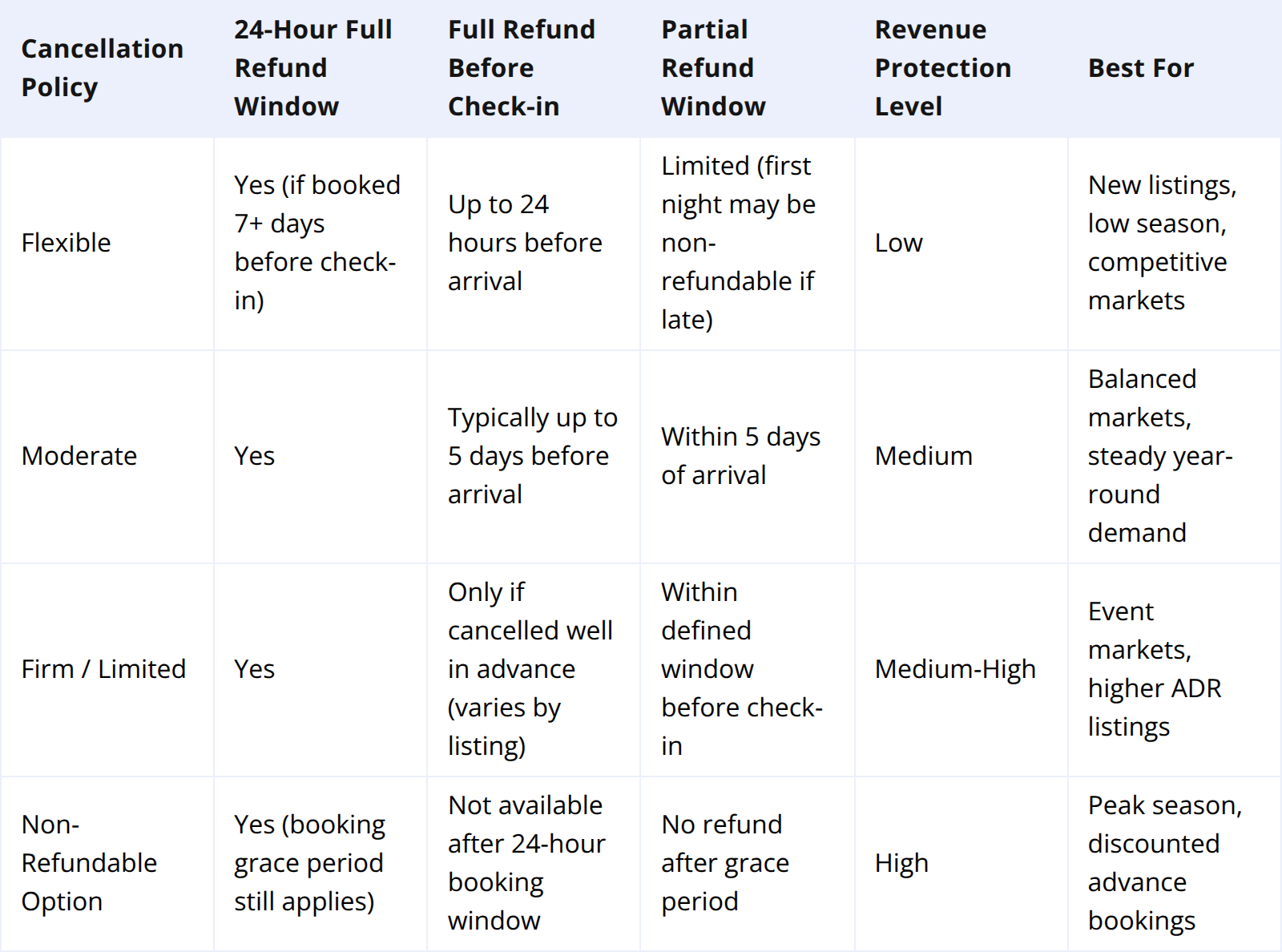
Short-Term Airbnb Cancellation Policies for Hosts
Airbnb cancellation policies for short-term stays (less than 28 nights) follow a standardized structure. All standard policies include a 24-hour full refund window, followed by different refund timelines depending on the level of flexibility the host selects.
Understanding this structure is essential for setting realistic revenue expectations.
Standard 24-Hour Full Refund Window
All short-term Airbnb cancellation policies include a 24-hour grace period.
Guests can cancel within 24 hours of booking and receive a full refund, as long as the reservation was made at least 7 days before check-in.
This rule applies regardless of whether you choose Flexible, Moderate, Firm, or other available policies. Hosts cannot remove this feature.
This 24-hour window is now the foundation of Airbnb cancellation policies for homes.
Flexible Cancellation Policy
Under the Flexible cancellation Policy, guests can typically cancel up to 24 hours before check-in and receive a full refund.
If cancellation happens less than 24 hours before arrival, the first night may be non-refundable.
This policy prioritizes booking conversion rate. It works well in competitive urban markets or during low season when attracting reservations is more important than maximizing protection.
Revenue risk is higher, but occupancy often improves.
Moderate Cancellation Policy
The Moderate cancellation Policy gives guests more flexibility than Firm but offers more protection than Flexible.
Guests usually receive a full refund if they cancel at least 5 days before check-in. If they cancel closer to arrival, partial refunds may apply.
This is often considered a balanced Airbnb cancellation policy for hosts who want reasonable revenue protection without discouraging cautious travelers.
Firm (or Limited) Cancellation Policy
Firm cancellation policies require guests to cancel further in advance to receive a full refund.
There is typically a short booking grace period, followed by stricter refund timelines. If cancellation occurs within a defined window before arrival, guests may only receive partial refunds.
Airbnb may label certain mid-level policies as Firm or Limited depending on market testing and regional rollout. Hosts should always review the exact wording shown on their listing page, as policy names can evolve.
Firm provides stronger host revenue protection compared to Moderate.
Non-Refundable Discount Option
Airbnb allows hosts to offer a non-refundable option in exchange for a discount.
Guests who select the non-refundable rate receive a lower price but agree that cancellations outside the 24-hour booking window will not qualify for a refund.
This strategy can stabilize cash flow during high-demand periods. However, the discount should be calculated carefully. Offering too large a reduction may reduce overall revenue without significantly reducing cancellation risk.
Non-refundable discounts work best for event dates, peak season bookings, or high-demand listings.
Long-Term and Special Cancellation Policy Situations
Short-term cancellation policies apply to stays under 28 nights. Longer stays follow different Airbnb long-term rental rules.
Long-Term Cancellation Policy (28+ Nights)
For reservations of 28 nights or more, Airbnb applies a separate long-term cancellation structure.
Guests are typically required to provide extended notice (often around 30 days) if they wish to cancel. The first month of a long-term stay is generally non-refundable.
If a guest cancels after check-in, they are usually responsible for the next 30 days of the reservation.
This structure protects hosts offering monthly stays by reducing sudden vacancy risk.
Hosts targeting remote workers or digital nomads should understand these monthly stay rules before promoting long-term availability.
When Airbnb Can Override Your Cancellation Policy
Even if you select a specific cancellation Policy, Airbnb reserves the right to override it in certain circumstances.
Under the Airbnb Major Disruptive Events Policy, the platform may issue refunds regardless of the host’s chosen policy if qualifying events occur. Examples may include:
- Large-scale natural disasters
- Government travel restrictions
- Official emergency declarations
Airbnb may also intervene if a listing is found to significantly differ from its description or if local consumer protection laws require alternative treatment.
These host refund overrides are part of Airbnb’s platform governance and cannot be disabled by the host.
Understanding this limitation is important when forecasting risk exposure, especially in regions prone to travel disruptions.
How to Change Your Cancellation Policy: A Step-by-Step Guide
Updating your Airbnb cancellation policies is simple:
- Log in to your Airbnb host dashboard.
- Go to “Listings.”
- Select the listing you want to edit.
- Click “Policies.”
- Choose your preferred cancellation Policy.
- Save changes.
New policies apply only to future bookings. Existing reservations remain under the cancellation Policy active at the time of booking.
Hosts should review policies quarterly, especially before peak season.
Pro Tips: How to Pick the Best Policy for Your Listing
Seasonal Strategy
Switch to Flexible during low season to increase occupancy. Use Strict or Firm during peak travel months for better revenue protection.
New Listing Strategy
New hosts often benefit from Flexible terms. More bookings lead to faster reviews, which improves listing optimization.
High-Value Property Strategy
Luxury homes or rare properties in prime areas perform well with Strict policies. Demand reduces refund risk.
Combine with Pricing Strategy
Use seasonal pricing and smart minimum stays to reduce short-notice gaps. A strong Airbnb hosting strategy integrates cancellation Policy with rate management.
Professional hosts often analyze cancellation patterns every 90 days to adjust policies based on real booking behavior.
FAQs related to Airbnb cancellation policies
Q1: Can a host cancel a reservation without penalty?
Hosts may cancel, but penalties usually apply. These can include cancellation fees, blocked calendar dates, and potential impact on Superhost status. Penalty-free cancellations may be granted in documented emergencies.
Q2: Does Airbnb refund the service fee to guests?
Airbnb service fees are often refunded if cancellation occurs within the full refund window. Outside that window, service fees may not be fully refundable. Exact rules vary by timing and booking type.
Q3: What happens if a guest cancels during their stay?
If a guest cancels after check-in, refunds depend on the listing’s cancellation Policy. Remaining nights may be partially refundable under Moderate or Firm policies. Under Strict, fewer refunds apply.
Q4: How does the “Firm” policy differ from “Strict”?
Firm offers more flexibility. It often includes a short booking grace period and partial refunds within a set time frame. Strict significantly limits refunds once close to arrival.
Q5: Can Airbnb override my cancellation policy for emergencies?
Yes. Under the Airbnb Major Disruptive Events Policy, the platform can override your selected cancellation Policy and issue guest refunds in qualifying emergency situations.
Final Thoughts
Airbnb cancellation policies are not just administrative settings. They are strategic tools. The right cancellation Policy protects host revenue, improves booking conversion rate, and supports listing optimization.
Hosts who regularly review refund trends, seasonality, and demand shifts make smarter decisions. A flexible approach in slow periods and a firm stance during peak demand can stabilize annual income.
Understanding how Airbnb handles cancellation, refund logic, and override situations ensures fewer surprises and stronger control over your hosting business.